How to Calculate Your Business’ Carbon Footprint
You don’t need to become a greenhouse gas (GHG) emissions expert, just like you don’t need to be a tax expert to run your business. What matters is having enough understanding to communicate with your team, your customers, and your stakeholders, while leaving the detailed work to the specialists.
This Carbon Accounting 101 guide gives you a high-level overview of how businesses calculate their carbon footprint, what data is typically included, and why it matters. If you’d like to dive deeper, explore the resources linked below or contact us, we’d be glad to answer your questions and guide you through the process.

Overview
Carbon accounting, also known as GHG accounting, is the process of quantifying the GHG emissions a business generates from its operations and value chain. It tracks units of carbon dioxide equivalent (CO2e), a standard measure that allows different greenhouse gases, such as methane and nitrous oxide, to be compared on a common scale.
The process involves collecting data on energy use, transportation, purchased goods, and other activities, then applying emissions factors to convert the primary data into GHG emissions. The result is a GHG inventory – a structured record of a business’ emissions across Scope 1, Scope 2, and Scope 3 (more on that below).
What is Carbon Accounting?
Carbon accounting is the foundation to understanding your business’ environmental impact. It provides a structured approach to quantifying greenhouse gas (GHG) emissions, building a realizable carbon footprint, and prepare for reporting and reduction efforts.
Why calculate a carbon footprint?
Measuring a business’ carbon footprint is becoming standard practice. Customers, investors, employees, and regulators increasingly expect businesses to measure and disclose their GHG emissions. It is a foundational step most businesses take as they develop their sustainability strategy and start establishing new initiatives.
Beyond meeting stakeholder expectations or compliance requirements, carbon accounting helps a business to look at their operations differently and uncover opportunities for efficiency and cost savings. By understanding where emissions come from, businesses can take an informed approach on their decarbonization planning and better prepare for a low-carbon economy.
What does Scope 1, 2, and 3 mean?
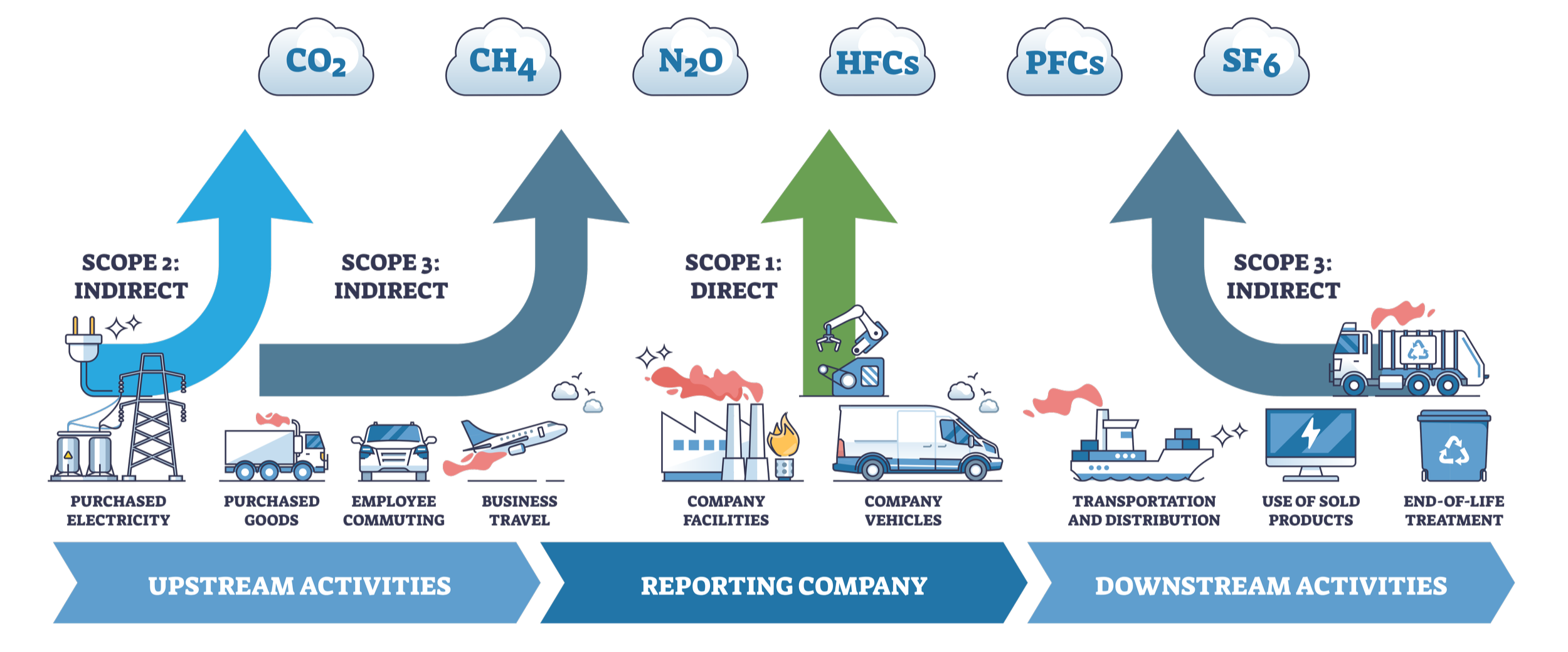
To assist in classifying the various sources of GHG emissions throughout a business’ value chain, they are classified into three different scopes. Scopes 1 and 2 cover emissions from sources a business owns or pays for directly, while Scope 3 includes all over indirect emissions across the value chain. Together, these scopes provide a complete picture of a business’ carbon footprint.
-
GHG emissions directly released by the reporting company. This can be from fuel combustion in furnaces of vehicles and the release of gases through process equipment.
Common sources: Building heating, fleet vehicles, and diesel generators
Common commodities: Natural gas, gasoline, diesel, propane, and refrigerants
-
GHG emissions generated in the production of the electricity consumed by the company. If applicable, it also include emissions from generation of purchased steam, heat, or cooling. Renewable electricity use is also included.
Common sources: Electricity
Common commodities: Electricity
-
Scope 3 represents all other sources of a business’ indirect emissions, both upstream and downstream.
It comprises of 15 subcategories that may be applicable to a company. Examples include business travel, employee commuting, supply chain, shipping and distribution, and downstream impacts of products.
How to Calculate a Carbon Footprint
Step 1: Collecting Usage Data From Your Facilities

Step 2: Convert Usage Data to GHG Emissions
After gathering activity data, the next step is to translate into GHG emissions. This requires applying two important tools: emissions factors and global warming potentials.
Emission factors (EFs) - numbers that convert activity data (like electricity use or fuel burned) into the amount of GHGs released
EFs convert activity data (e.g. kilowatt-hours of electricity use or gallons of fuel) into the amount of GHG emissions it produces. These emission factors are often region-specific — for example, electricity in California may have a different factor than electricity in Maryland — and are published by organizations like the U.S. EPA. Because factors are updated regularly to reflect changes in the energy mix and technologies, it is best practice to to use the most current version available.
Global Warming Potentials (GWPs) - Ratios that compare the warming impact of different cases to CO2, so all emissions can be expressed in a single unit (CO2e)
GWPs make it possible to compare different greenhouse gases on the same scale. Each gas has a different heat-trapping effect, and GWPs translate them into a common unit: carbon dioxide equivalent (CO2e). For example 1 kg of methane (CH4) has 28 times the warming impact of 1 kg of carbon dioxide (CO2). By applying the GWPs, emissions of various gases can be combined and expressed in a single, comparable number.
Calculating a GHG inventory starts with collecting data for the different sources of emissions from your business activities. For most businesses, Scope 1 and Scope 2 are relatively straightforward to calculate using using utility bills and invoices. Scope 3 can be more complex, since it covers a wider range of categories across a business’ value chain.
Scope 1 Data Sources: Natural gas utility bills, invoices for delivered fuels, or purchase records of refrigerants and other gases
Scope 2 data sources: Electric utility bills and any contracts for renewable energy use
Scope 3 data sources: Company expense reports (covering both indirect/overhead and direct/product or service-related), travel summaries, employee commuting and remote work data, and in some cases, information related to product use and sales
If you don’t have access to all of the utility bills or data, that’s okay. Standard methodologies exist to estimate usage where records are incomplete, and The GHG Shoppe can help determine where higher-quality data will add the most value in future reporting cycles.
Greenhouse Gas Accounting Resources
How The GHG Shoppe Can Help Your Business
Outsourced carbon accounting for SMEs
Most businesses don’t have in-house sustainability teams, and you shouldn’t need to become a GHG expert to meet today’s expectations. The GHG Shoppe acts as your outsourced carbon accounting partner, managing the process from start to finish so you can focus on running your business.

Expert guidance without the learning curve
We leverage our expertise to streamline carbon accounting for your business. We manage the methodologies and reporting rules and you get practice guidance, clear data requests, and a process that saves you time and reduces risk.

Audit-ready GHG inventories you can trust
We follow the WRI/WBCSD Greenhouse Gas Protocol Corporate Standard and use recognized emissions factor datasets, ensuring each carbon footprint is accurate, consistent, and defensible. You receive an audit-ready GHG inventory you can confidently share with your stakeholders.